How to make sure your mail is read

ThinkGeek have a bit of a challenging audience to connect with. Many of their customers are, well, geeks. And many geeks have a reputation for being suspicious of marketing. I’d even go so far as to say that ThinkGeek has a bigger marketing challenge than other popular retailers.
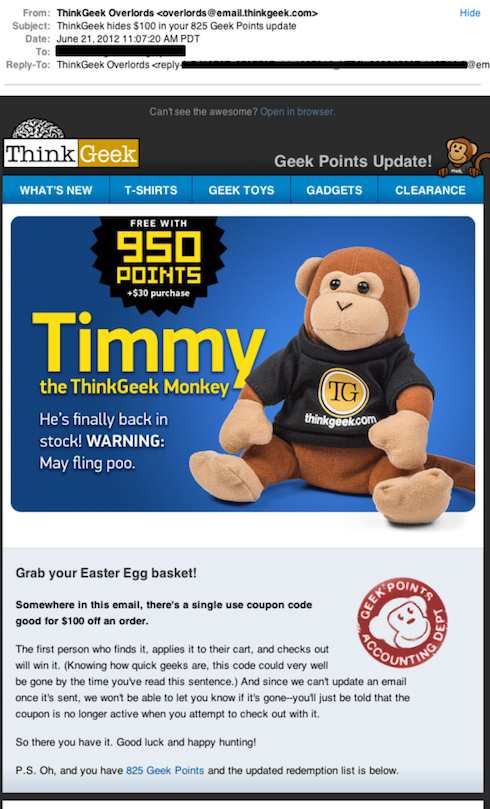
One of the challenges all marketers face, though, is getting people to actually open and read an email carefully. ThinkGeek have addressed this challenge by turning reading email into a competitive game.
In June they sent out an email with a hidden coupon code in it. The first person to redeem the code received $100 off their order. What a creative way to get people to actually look through an email and make a purchase.
This, of course, is not a new marketing technique. I have at least 2 different Sigma t-shirts using the same style of marketing. This was in the dark ages and we didn’t have online forms, but the new catalog came with a postcard of questions to answer and return and the first 100 post cards got t-shirts. It was actually kinda nifty. As head tech, I got catalogs all the time. But answering the questions got me to look through the Sigma catalog and see their new products. Plus! T-shirt!
What new an interesting ways have you seen marketers use to engage recipients?

Related Posts

Email and politics

I occasionally consult for activists using email. Their needs and requirements are a little different from email marketers. Sure, the requirements for email delivery are the same: relevant and engaging mail to people who requested it. But there are complicating issues that most marketers don’t necessarily have to deal with.
Activist groups are attractive targets for forged signups. Think about it, when people get deeply involved in arguments on the internet, they often look for ways to harass the person on the other end of the disagreement. They will often signup the people they’re disagreeing with for mailing lists. When the disagreements are political, the logical target is a group on the other side of the political divide.
People also sign up spamtraps and bad addresses as a way to cause problems or harass the political group itself. Often this results in the activist group getting blocked. This never ends well, as instead of fixing the problem, the group goes yelling about how their voice is being silenced and their politics are being censored!!
No, they’re not being silenced, they’re running an open mailing list and a lot of people are on it who never asked to be on it. They’re complaining and the mail is getting blocked.
With that as background, I noticed one of the major political blogs announced their brand new mailing list today. Based on their announcement it seemed they that they may have talked to someone who knew about managing a mailing list.

Read More

Delivery and marketing part 2

A while ago I wrote some thoughts about the conflicting requirements of delivery and marketing. I posted something similar over on the Only Influencers list, too. My thoughts generated a very interesting discussion, one that helped me clarify some of my somewhat random thoughts from earlier.
Marketing is about finding mindshare. One way you get mindshare is repetition. But people tune out repetition pretty quickly. Sending the same offers, the same copy over and over again means recipients start to tune things out.  When recipients start tuning out mail, they may not bother opening it, they just read the subject line.  If too many recipients start relying on the subject line then delivery can suffer.
Effective marketing relies on getting mail in front of the target audience. That’s the delivery component. Without inbox delivery, even the best marketing will not work.
No one will see marketing if it is in the spamfolder.
I don’t think you can cleanly separate delivery strategy from marketing strategy, but it’s important to realize they have different constraints and different pressures. When I talk about delivery with a client, I’m talking about getting mail into the inbox. And, most of the time, they’ve come to me because they’re not getting into the inbox and they have to make changes. The genius of their marketing is irrelevant, because no customers see it.
But once mail is in the inbox you can’t just ignore delivery, either. Sure, it becomes less of a pressure on the copy and the marketing strategy, until such time as the mail isn’t getting into the inbox any longer. Then it’s back to working on delivery and maybe having to implement some aggressive data hygiene. Back in the inbox and you can be aggressive on the marketing again.
Successful email marketing requires balancing the constraints of good delivery against the constraints of good marketing.

Read More

How not to build a mailing list

I mentioned yesterday one of the major political blogs launched their mailing list yesterday. I pointed out a number of things they did that may cause problems. Today, I discovered another problem.
This particular blog has been around for a long time, probably close to 10 years. It allows anyone to join and create their own blogs and comment with registered users. As part of their new mailing list, they added everyone who has ever registered to their mailing list. They did not send a “we have a new list, want to join it?” email, they added every registered user to the list and said “you can opt out if you want.”
This is such a bad idea. My own account was used once, to make one comment, back in 2005. Yes, 2005. It’s been almost 5 years since I last logged into the site. Sure, I have email addresses that go back that far, but not everyone does. That list is going to be full of problems: dead addresses, spamtraps, duplicates, unengaged and uninterested.
Seriously, they’re adding people who’ve not logged into their site in 5 years to a mailing list. How can this NOT go horribly wrong?
My initial thought was this was going to blow up in a week. I’m now guessing they’ll start seeing delivery problems a lot sooner than that.

Read More