I cannot feel the Bern.

On a lark (and to do my best to stay as informed as possible via primary sources) I decided to sign up for the official mailing lists of the Trump, Clinton, and Sanders campaigns.
Both Trump and Clinton were happy to take my email address and add it to their distribution lists, no confirmation required. Not terribly surprising, since they need to make it as easy as possible to get their messages out to anyone who will listen.
On to the Sanders campaign.
I… couldn’t figure out how to subscribe to Sanders’ mailing list.
I feel I must have missed something obvious. I’m certainly not saying that I’m a super-genius or anything… but, at the same time, if I can’t figure out how to get your mail, then it might just be that others are having similar problems.
The first obvious place to sign up for updates was the big blue “This is your movement” box. That route requires a donation to proceed. Back to the main page.
The next option would sign me up for mobile alerts. No thanks.
All the way at the bottom of the page, a final big blue box asks, “Are you ready?” Somewhat beyond ready, I entered my information, clicked “Join us” and held my breath.
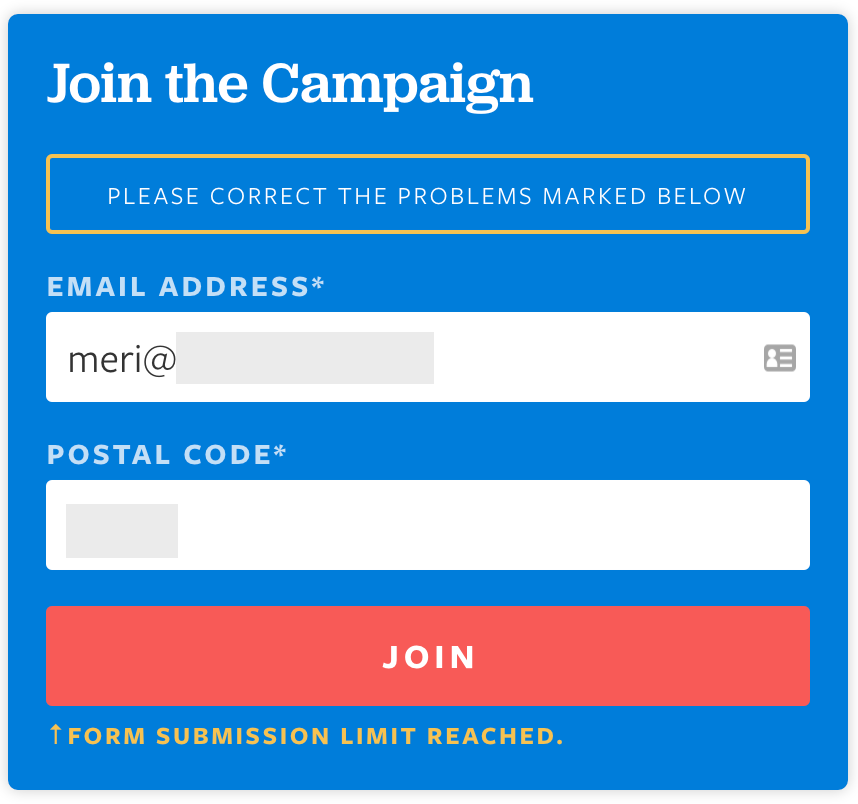
I Cannot Feel the Bern
The “Form submission limit reached” error is likely indicative of the use of outsourced product or service being used to collect and manage contact information on behalf of the campaign. My actually seeing this error is indicative of insufficient testing of the site by the campaign.
I’m sure the developer promised a bulletproof site, and it seems the campaign took this on faith. But at least one thing fell through cracks, resulting in the campaign not just losing an avenue of communication with someone who has self-selected as interested, but also potentially diminishing that person’s opinion of how the campaign manages the finer points, and wondering how that ultimately reflects on the candidate. Ultimately, it doesn’t matter whether or not the campaign developed the site themselves or hired someone else to do it on their behalf. All that matters is that they put their name on it, and let it speak for their brand.
Campaigning is sales. Whether you’re selling a candidate or a stock portfolio or a hand-made product, when you invite your audience to interact with you online, they must find the experience to have been worth their time, otherwise they’re unlikely to take you up on any future invitations. In business, as in politics, there’s a lot on the line, communication is vital, and mastering digital interaction with the public is no longer optional.
And while I was writing this post, I started receiving mail from the Sanders’ campaign. So I guess I could subscribe after all.
Related Posts

Get an email address, by any means possible

Neil has a post up about the “opt-in” form that we were all confronted with when logging into the hotel wifi at M3AAWG last week.  They aren’t the only hotel asking for email addresses, I’ve seen other folks comment about how they were required to provide an email address AND opt-in to receive email offers before they were allowed onto the hotel network. Mind you, they’re paying the outrageous fees for hotel internet and still being told they must provide an email address.
The addresses given by people who wouldn’t opt-in willingly aren’t going to be worth anything. These are not people who want your mail, they’re only giving you an address because they’re being forced to do so.
I know it is so tempting for marketers to use any methods to get an email address from customers. I recently was dealing with a very poorly delivering list that looked purchased. There were clear typos, invalid domains, non-existent domains, the whole nine yards. Over 20% of the mail was bouncing and what did get delivered wasn’t going to the inbox. I was working through the problem with the ESP before they went to talk to the customer. To my eye, the list looked purchased. Most times lists just don’t look that bad when they are actually opt-in lists. The ESP insisted that the addresses were being collected at their brick and mortar stores at point of sale. I asked if the company was incentivizing address collection, but the ESP didn’t know.
Eventually, we discovered that the retailer in question had set performance indicators such that associates were expected to collect email addresses from 90% of their customers. No wonder the lists looked purchased. I have no doubt that the pressure to give an email address caused some customers to just make up random addresses on the fly. I also wouldn’t be surprised if some associates, after failing to meet the 90% goal, would just enter random addresses in “on behalf of” the customer.
Email is a great way to stay in touch with customers. It is an extremely cost effective and profitable way to market. The caveat is that customers have to want that mail. Coercing a customer to give you an address doesn’t make your marketing better. It just makes your delivery harder. That lowers your overall revenue and decreases profits.
Quantity is not the be all and end all of marketing. This company? They have a great email marketing program, but their address collection is so bad hardly anyone gets to see the mail in the inbox, even the people who would be happy to receive the mail.
For email delivery quality trumps quantity every time.

Read More

Deliverability advice to the DNC

I was working on another post for this afternoon, but when I checked Facebook Autumn Tyr-Salvia had posted a link that’s much more interesting to talk about.
It seems the Democratic National Committee has acquired President Obama’s email list from the 2012 campaign.

Read More

Where did you get my address?

Both Steve and I are trying to get answers from Amazon, Target and Epsilon about how Target acquired our Amazon specific email addresses. Target phone reps told us the mail we got was a phish, Epsilon is refusing to acknowledge Target is a customer and Amazon has promised us “they’re looking into it.”
Meanwhile, an address of mine was transferred from one customer of an ESP to another customer of the same ESP. At first I was told I must have signed up for the mail; as proof I was provided with the data I supposedly signed up. When I explained no that wasn’t true, the abuse desk told me they had discovered there was a mistake and that “These two clients use the same 3rd party ESP and they had mixed the files.” I’m not actually sure who “they” refers to, but as long as they’ve untangled the files I am not going to argue. The sad part is that it took an escalation to Return Path (the IP sending the mail is certified) to get anyone to actually respond to my report of an address given to Company A being mailed by Company B.
On the flip side, mail showed up today that actually had a link for “how was I added?”
Atari_Optout
When you click on the link it shows exactly where the address came from and when it was added to the list.
How_was_I_added_to_this_list_
It would be great if more companies provided this information to their recipients. I think it would probably decrease spam reports and make consumers feel more comfortable about how companies are collecting and using information.

Read More