Improving Gmail Delivery

Lately I’m hearing a lot of people talk about delivery problems at Gmail. I’ve written quite a bit about Gmail (Another way Gmail is different, Gmail filtering in a nutshell, Poor delivery at Gmail but no where elseInsight into Gmail filtering) over the last year and a half or so. But those articles all focus on different parts of Gmail delivery and it’s probably time for a summary type post.

Gmail is different

There are two major reasons that Gmail filtering is different from the other webmail providers: when it was launched and who it was launched by.
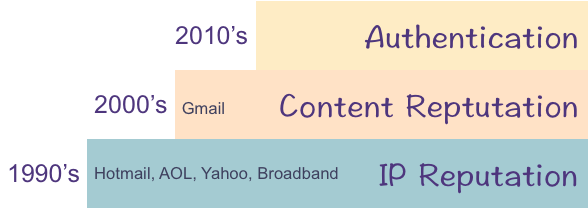
Gmail entered the mail market late in the internet era when compared to other free email providers. AOL offered internet email in 1992; Yahoo Mail opened in 1994; Hotmail debuted in 1996. When these systems were in development, spam wasn’t an issue.
Spam filtering was added later, as the problem grew. Gmail didn’t launch until 2004, nearly a decade after their current competitors. Spam was already a problem by 2004, so Gmail was able to build filters in from the beginning.
The other real difference is Google’s experience and expertise in search. They built their business on being able to take lots and lots of data, categorize it and make it instantly searchable. This actually translates well to spam filtering, in that they take lots of data, categorize it and put it in appropriate mailboxes.
Those aren’t the only reasons Gmail is different. Another factor is Gmail’s attitude towards senders. The prime example is their FBL. Unlike most ISPs, Gmail doesn’t provide the full message back in its FBL. Instead, they give a count of complaints. They’re not going to help senders remove folks who complain. The flip side of this is they are leading the way in providing easier ways to unsubscribe.
The different history, expertise, and attitude of Google are the core of why Gmail delivery is so unlike others.

Metrics look great

The standard diagnostic for problem is to investigate the metrics, identify areas where they show limits and work to improve them. Along the way, email delivery improves. At Gmail, however, there’s often nothing obviously wrong with the metrics. The problem is the metrics we’re using are measuring symptoms not identifying underlying issues. Think of all the metrics we use as a fever. Just because a fever is gone (or you don’t have one) doesn’t mean you’re not sick.
Metrics are proxy measurements. The best metrics in the world aren’t going to help your delivery at Gmail if the recipients don’t want your mail.
The Recipient Has To Want Your Mail.

Why is Gmail so hard?

Because Gmail is smarter than we are.
Because Gmail looked at the things other companies did and learned what worked to decrease spam and what worked to decrease signs of spam (those are different things).
Because Gmail has years and years of experience in dealing with people who game SEO listings.
Because Gmail puts the user experience ahead of the sender experience.
Related Posts

Active buttons in the subject line

This morning I waded into a twitter discussion with a bunch of folks about some issues they were having with delivery to gmail. The discussion started with a blog post at detailed.com describing how some senders are seeing significant drops in open rates. I thought I’d take a look and see if I can help, because, hey, this is an interesting problem.
I signed up for a bunch of the mail that was seeing gmail problems and discovered that one of them had the confirmation link in the subject line. How cool is that?

I’ve known about the Gmail subscription line functionality for a while, but this is the first time I’ve seen it in the wild.
The action is in a <div> tag at the bottom of the email. Gmail has been allowing actions in subject lines for a while, this is just the first time I’ve seen it used for subscriptions. It’s so cool.
Want to add one to your post? Instructions are available from Google on their Email Markup pages.

Read More

Sharing access to Google Postmaster Tools

As a delivery consultant, I always ask clients to share their Google postmaster reports with me. As Gmail is one of the bigger delivery challenges for a lot of senders, having access to the postmaster tools helps tease out issues. I had some issues earlier this week getting access to tools and so brought up a conversation on one of the delivery lists. The nice folks there helped me get it solved.
A few hours later someone asked me how do I get access and I thought that was a brilliant idea for a blog post today.

Read More

I'm not a customer any more

We recently moved co-working spaces, after 8 or 9 years in the same place.  I’ll be up front here, we left Space A because I was annoyed with them. I’ve been increasingly unhappy with them for a while, but moving is a pain so just put up with them. But their most recent rent increase along with the lost packages, increasing deposit requirements and revolving door of incompetent staff finally drove us to find a new co-working space.
On the 15th of the last month of our contract, I started receiving marketing emails from Space A. I just deleted a couple of them but finally decided I didn’t want to ever see their name again. I tried to unsubscribe.

Gotta give them credit. Checkboxes for everything, except some of them are to opt-in and some of them are to opt-out. This is the kind of interface marketers use to confuse folks and limit the actual number of opt-outs. I’ll admit, the first time I tried to opt-out, I probably did it wrong. But, I know CAN SPAM says they have 10 days, and I know many marketers take advantage of that so I wait a while and keep deleting the messages that show up in my mailbox.
That was late June. By early July I realize it’s been more than 10 days and I’m still getting mail from them. So I click another opt-out link. This time I notice I need to uncheck most boxes, but check the bottom one. OK, fine, you got me, I didn’t read and didn’t correctly opt-out the first time. This time I will.
I continue to receive email. I continue to delete the email. We run our own mail system so I don’t have the benefit of a this-is-spam button, but you can bet if I did I would have used it, on every message I received after my first attempt to opt-out.
This week, after getting yet more mail, I start digging. What ESP are they using that’s bungling the opt-out process? Ah. I know that ESP. So I send in a complaint to abuse@ESP asking them to please make their customer stop mailing me. I also go, once again, to the preference page and submit an opt-out request. Because, hey, maybe third time is a charm?
12 hours later I get yet another mail from them. Really? REALLY? OK. Now I’m moving from annoyed to irate. First step: figure out if I know anyone working at said ESP. Ah, right, them. I have a lot of respect for this colleague, so I send a heads up pointing out that their customer isn’t honoring unsubscribes and can they take a look at what might have broken in their unsubscribe process.
This morning they tell me they looked into my subscription and have not registered any opt-out request until the one this week. The other two? Not recorded in their system. “Does this match your recollection of what happened?” No. No it doesn’t. I know I clicked on unsub links at least 3 times and only one of those clicks is recorded.
At this point, I’m pretty sure I’ll be suppressed by the ESP so I won’t have to get mail from Space A any longer. That fixes the annoyance on my end. But I can’t help thinking about how horrible this interaction was, both from a deliverability perspective and from a customer perspective.

Read More