Warmup advice for Gmail

Getting to the Gmail inbox in concept is simple: send mail people want to receive. For a well established mail program with warm IPs and domains, getting to the inbox in practice is simple. Gmail uses recipient interaction with email to determine if an email is wanted or not. These interactions are easy when mail is delivered to the inbox, even if the user has tabs enabled.
When mail is in the bulk folder, even if it’s wanted, users are less likely to interact with the mail. Senders trying to change their reputation to get back to the inbox face an uphill battle. This doesn’t mean it’s impossible to get out of the bulk folder at Gmail, it’s absolutely possible. I have many clients who followed my advice and did it. Some of these clients were simply warming up new IPs and domains and needed to establish a reputation. Others were trying to repair a reputation. In both cases, the fixes are similar.

When I asked colleagues how they handled warmup at Gmail their answers were surprisingly similar to one another. They’re also very consistent with what I’ve seen work for clients.

Warmup Advice

Start small. Gmail recommends starting out with 10 – 20 emails at a time. They mean it. You can send this low number of emails every few hours, so you’re not stuck at 10 emails per day. Do not try to send even 100 emails on your first send for a new IP / domain combination. That mail will end up in the bulk folder.
Send to hyper engaged users. Simple engagement isn’t enough. You need to mail those people who are going to miss your mail and track it down if it’s in the bulk folder.
Sign up for Postmaster tools.  Use the tools, Padawan.
Expect it to take 4 – 6 weeks to fully warm a mailstream at Gmail. It will feel very slow in the beginning, when you’re sending out 100 emails over 10 hours. But that’s the right way to warm at Gmail. Once you are getting that mail to the inbox then you can start doubling volume every few hours.
You will need to warmup each domain/IP pair individually. Don’t expect that you can take a warm IP and add a new domain, or even subdomain, and not have to go through warmup. You will. Don’t expect to take a warm domain and get good delivery off a new IP. Gmail is really focused on the overall reputation of the mailstream, and making changes will lower or reset reputation.
If you get into trouble, slow down and back off. Refocus on your engaged users.
Some senders see problems if the mix engaged and new users into the early streams of mail.
It’s not impossible to warmup a new IP at Gmail, but it is a little different than warmup at some other places. It may feel too slow and too frustrating, but keep at it with those engaged users and it will happen.
 

Related Posts

Active buttons in the subject line

This morning I waded into a twitter discussion with a bunch of folks about some issues they were having with delivery to gmail. The discussion started with a blog post at detailed.com describing how some senders are seeing significant drops in open rates. I thought I’d take a look and see if I can help, because, hey, this is an interesting problem.
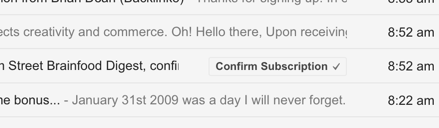
I signed up for a bunch of the mail that was seeing gmail problems and discovered that one of them had the confirmation link in the subject line. How cool is that?

I’ve known about the Gmail subscription line functionality for a while, but this is the first time I’ve seen it in the wild.
The action is in a <div> tag at the bottom of the email. Gmail has been allowing actions in subject lines for a while, this is just the first time I’ve seen it used for subscriptions. It’s so cool.
Want to add one to your post? Instructions are available from Google on their Email Markup pages.

Read More

Another way Gmail is different

I was answering a question on Mailop earlier today and had one of those moments of clarity. I finally managed to articulate one of the things I’ve known about Gmail, but never been able to explain. See, Gmail has never really put a lot of their filtering on the SMTP transaction and IP reputation. Other ISPs do a lot of the heavy lifting with IP filters. But not Gmail.
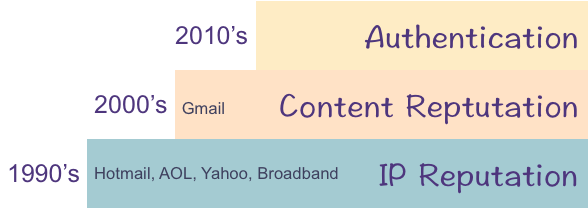
While I was writing the answer I realized something. Gmail was a late entrant into the email space. AOL, Hotmail, Yahoo, even the cable companies, were providing email services in the 90s. When spam started to be a problem, they started with IP based blocking. As technology got better and content filtering became viable, improvements were layered on top of IP based blocking.

Gmail didn’t enter the mailbox market until the 2000’s. When they did, they had money, lots of hardware, and internal expertise to do content filtering. They didn’t start with IP based filtering, so their base is actually content filtering. Sure, there were some times when they’d push some mail away from the MTAs, but most of their filtering was done after the SMTP transaction. The short version of this is I never really pay any attention to IP reputation when dealing with Gmail. It’s just another factor. Unless you’re blocked and if you get blocked by Gmail, wow, you really screwed up.
Gmail does, of course, do some IP based blocking. But in my experience IP filters are really only turned against really egregious spam, phishing and malicious mail. Most email marketers reading my blog won’t ever see IP filters at Gmail because their mail is not that bad.
Other companies aren’t going to throw away filters that are working, so the base of their filters are IPs. But Google never had that base to work from. Their base is content filters, with some IP rep layered on top of that.
That’s a big reason Gmail filters are different from other filters.

Read More

Insight into Gmail filtering

Last week I posted a link to an article discussing how Gmail builds defenses to protect their users from malicious mail. One of the things I found very interesting in that article was the discussion about how Gmail deploys many changes at once, to prevent people from figuring out what the change was.
Let’s take a look at what Gmail said.

Read More