Recent Posts
Naming Names
- laura
- Feb 23, 2017
One of the things that regularly happens at email conferences is a bunch of representatives from various ISPs and sometimes deliverability companies get up on stage and entertain questions from the audience about how to get email to the inbox. I’ve sat in many of these sessions – on both sides of the stage. The questions are completely predictable.
Almost invariably, someone asks if they can quote the ISP representative, because there is this belief that if you connect a statement with an employee name that will give the statement more weight. Except it doesn’t really. People who aren’t going to listen to the advice won’t listen to it even if there are names attached.
A lot of what I publish here is based on things the ISP reps have said. In some cases the reps actually review and comment on the post before I publish it. I don’t really believe attaching names to these posts will make them any more accurate. In fact, it will decrease the amount of information I can share and will increase the amount of time it takes to get posts out.
Last night I was joking with some folks that I should just make up names for attribution. Al did that many years ago, coining the pseudonym Barry for ISP reps. Even better, many of the ISP employees adopted Barry personas and used them to participate in different online spaces. Barry A. says X. Barry B. says Y. Barry C. says W. Barry D.
It doesn’t matter what names I attach.
I think I’m going to start adding this disclaimer to the appropriate blog posts:
Any resemblance to persons living or dead should be plainly apparent to them and those that know them. All events described herein actually happened, though on occasion the author has taken certain, very small, liberties with narrative.
Because, really.
Network Abuse
- laura
- Feb 22, 2017
Many years ago, back when huge levels of spam involved hundreds of thousands of emails, there was a group of people who spent a lot of time talking about what to do about abuse. One of the distinctions we made was abuse of the net as opposed to abuse on the net. We were looking at abuse of the network, that is activity that made the internet less useable. At the time abuse of the network was primarily spam; sure, there were worms and some malicious traffic, but we were focused on email abuse.
In the last 20 years, multiple industries have arisen around network abuse. I’m sitting at a conference with hundreds of people discussing how to address and mitigate abuse online. In the context of the early discussions, we’re mostly focused on abuse of the network, not abuse on the network.
But abuse on the network is an issue. It’s a growing issue, IMO. The internet has contributed to the rise and normalization of the alt-right. Social media is a medium used for abuse on the net. Incidents range from bullying of school kids to harassment of celebrities to sharing of child abuse material. All of these things are abuse on the net. They are an issue. They need to be addressed.
Today M3AAWG gave the 2017 Mary Litynski Award to Mick Moran from Interpol for his work in fighting child exploitation and abuse on the net. As I tweeted during the session, I have a phenomenal amount of respect for Mick and people like him who work tirelessly to protect children online. I don’t talk much about child abuse materials*, but I know the problem is there and it’s bad.
One of the discussions I’ve had with some folks lately is how we can better fight abuse on the net. Many of the tools we’ve built over the years are focused on volume – more complaints mean a more serious incident. But in the case of abuse on the net, or who is wrong. volume isn’t really an issue. It’s a hard problem to solve. It’s easy to create a system that lets the good guys get information, but it’s hard to create a system that also keeps the bad guys out and prevents gaming and is effective and values single complaints of problems.
Folks like Mick, and the abuse teams at ISPs all over the world, are integral to finding and rescuing abused and exploited children. Their work is so important, and most people have no idea they exist. On top of that, the work is emotionally difficult. Some of my friends work in that space, dealing with child abuse materials, and all of them have the untold story of the one that haunts them. They don’t talk about it, but you can see it in their eyes and faces.
We can do better. We should do better. We must do better.
*Note: Throughout this post I use the term “child abuse materials” to describe what is commonly called child pornography. This is because porn isn’t necessarily bad nor abusive and the term child porn minimizes the issue. It’s important to make it clear that children are abused, sometimes for years, in order to make this material.
It's that time of year again!
- laura
- Feb 20, 2017
That time of year when my friends and colleagues join the annual migration to San Francisco for 3 days and 4 nights of messaging, mobile, malware, and midnight meetings. We’re headed up to the conference later today. Do stop by and say hi!
Read MoreWhy so many IP addresses?
- steve
- Feb 17, 2017
Hi Laura,
Read More
Merry Xmas and wishing you a Happy New Year!
I recently looked at a popular ESP’s IPv4 space and I was astounded. How does an ESP get an IP allocation of 20,480 IPs? ARIN guidelines do not allow “MX/Mailing” IPs to count towards a valid justification especially in the case when each and every IP is being used for this purpose. That’s 80 /24’s…and at a time when we are out of IPv4 space….Would love to see a blog post with your insight about this issue….
From the archives: Taking Permission
- laura
- Feb 17, 2017
From February 2010, Taking Permission.

Marketers have responded by setting up processes to “get” permission from recipients before adding them to mailing lists. They point to their privacy polices and signup forms and say “Look! the recipient gave us permission.”
In many cases, though, the permission isn’t given to the sender, permission is taken from the recipient.
Yes, permission is being TAKEN by the sender. At the point of address collection many senders set the default to be the recipient gets mail. These processes take any notion of giving permission out of the equation. The recipient doesn’t have to give permission, permission is assumed.
This isn’t real permission. No process that requires the user to take action to stop themselves from being opted in is real permission. A default state of yes takes the actual opt-in step away from the recipient.
Permission just isn’t about saying “well, we told the user if they gave us an email address we’d send them mail and they gave us an email address anyway.” Permission is about giving the recipients a choice in what they want to receive. All too often senders take permission from recipients instead of asking for permission to be given.
Since that post was originally written, some things have changed.
CASL has come into effect. CASL prevents marketers from taking permission as egregiously as what prompted this post. Under CASL, pre-checked opt-in boxes do not count as explicit permission. The law does have a category of implicit permission, which consists of an active consumer / vendor relationship. This implicit permission is limited in scope and senders have to stop mailing 2 years after the last activity.
The other change is in Gmail filters. Whatever they’re doing these days seems to really pick out mail that doesn’t have great permission. Business models that would work a few years ago are now struggling to get to the inbox at Gmail. Many of these are non-relationship emails – one off confirmations, tickets, receipts. There isn’t much of a relationship between the sender and the recipient, so the filters are biased against the mail.
Permission is still key, but these days I’m not sure even informed permission is enough.Read More
Are seed lists still relevant?
- laura
- Feb 16, 2017
Those of you who have seen some of my talks have seen this model of email delivery before. The concept is that there are a host of factors that contribute to the reputation of a particular email, but that at many ISPs the email reputation is only one factor in email delivery. Recipient preferences drive whether an email ends up in the bulk folder or the inbox.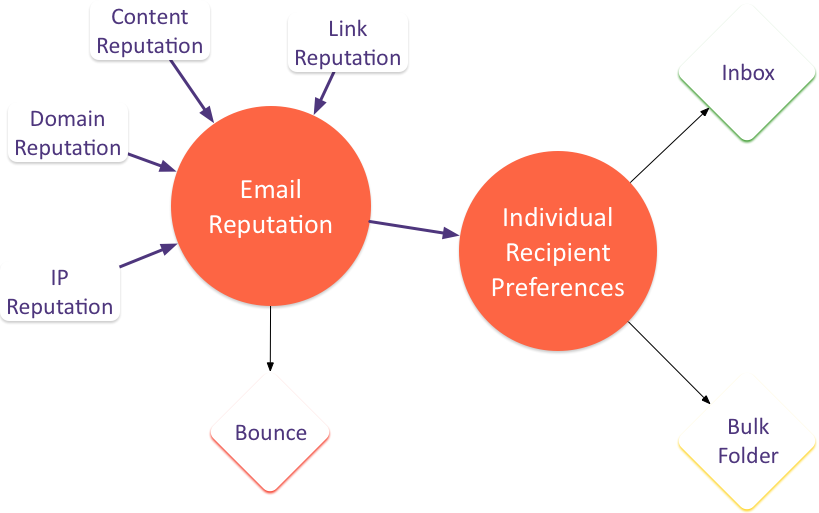
The individual recipient preferences can be explicit or implicit. Users who add a sender to their address book, or block a sender, or create a specific filter for an email are stating an explicit preference. Additionally, ISPs monitor some user behavior to determine how wanted an email is. A recipient who moves an email from the bulk folder to the inbox is stating a preference. A person who hits “this-is-spam” is stating a preference. Other actions are also measured to give a user specific reputation for a mail.
Seed accounts aren’t like normal accounts. They don’t send mail ever. They only download it. They don’t ever dig anything out of the junk folder, they never hit this is spam. They are different than a user account – and ISPs can track this.
This tells us we have to take inbox monitoring tools with a grain of salt. I believe, though, they’re still valuable tools in the deliverability arsenal. The best use of these tools is monitoring for changes. If seed lists show less than 100% inbox, but response rates are good, then it’s unlikely the seed boxes are correctly reporting delivery to actual recipients. But if seed lists show 100% inbox and then change and go down, then that’s the time to start looking harder at the overall program.
The other time seed lists are useful is when troubleshooting delivery. It’s nice to be able to see if changes are making a difference in delivery. Again, the results aren’t 100% accurate but they are the best we have right now.
Truth, myths and realities
- laura
- Feb 14, 2017
For a long time it was a known fact that certain ISPs recycled abandoned addresses into spamtraps. There were long discussions by senders about this process and how it happened. Then at a conference a few years ago representatives of ISPs got up and announced that they do not recycle addresses. This led to quite a bit of consternation about how deliverability folks were making things up and were untrustworthy and deceptive.
In the early 2000’s ISPs were throwing a lot of things at the wall to deal with mail streams that were 80 – 90% bulk. They tried many different things to try and tame volumes that were overwhelming infrastructure. ISPs did try recycled traps. I know, absolutely know, two did. I am very sure that others did, too, but don’t have specific memories of talking to specific people about it.
At that time, a lot of deliverability knowledge was shared through word of mouth. That turned into a bit of an oral history. The problem with oral history is that context and details get lost. We can use the story of the ISP that did/did not recycle traps as an example.
Deliverability folks talk about an ISP that recycles traps. They don’t mention how often it happens. Some folks make the assumption that this is an ongoing process. It’s not, but anyone who knows it’s not risks violating confidences if they correct it. Besides, if senders believe it’s an ongoing process maybe they’ll be better behaved. Eventually, the story becomes all ISPs recycle traps all the time. This is our “fact” that’s actually a myth.
Then an ISP employee goes to a conference an definitively states they don’t recycle traps. I believe he stated the truth as he knows it to be. That ISP moved on from recycled traps to other kinds of traps because there were better ways to monitor spam.
We were talking about this on one of the deliverability lists and I told another story.
[ISP] recycled addresses once – back when JD was there which must have been, oh, around 2005/6 or so. I heard this directly from JD. It wasn’t done again, but a whole bunch of people just assumed it was an ongoing thing. Since my knowledge was a private conversation between JD and me, I never felt comfortable sharing the information. Given the circumstances, I’ve decided it’s OK to start sharing that end of the story a little more freely.
No one set out to create a myth, it just happened. No one intended to mislead. But sometimes it happens.
Subscription transparency
- laura
- Feb 10, 2017
I regularly tell clients to be transparent with their sends. With email, permission is better than forgiveness. A surprise change in mail frequency or type leads to complaints. Complaints lead to bulk foldering. Once mail is in the bulk folder, it’s hard to get out of there, particularly at some webmail providers.
The permission is better than forgiveness is hard for a lot of senders to understand. Much of marketing is about assuming the yes in the absence of a no. Sure, they’ll back off when there’s a no, in DMA terms it’s the “one bite at the apple rule.” Unfortunately for senders the one bite rule doesn’t work in the email space.
There are a couple reasons that permission is better than forgiveness in the email space. The biggest is that the ISPs own the mailbox and as the owners they make decisions about who gets access. They prioritize the wants and needs of their customers / users over the wants and needs of advertisers. It’s easy for users to give feedback; in many cases they just have to hit a button. But that’s another whole blog post.
Today I get an email from The Guardian. They’re modifying and expanding their newsletter program, so they sent subscribers an update about it.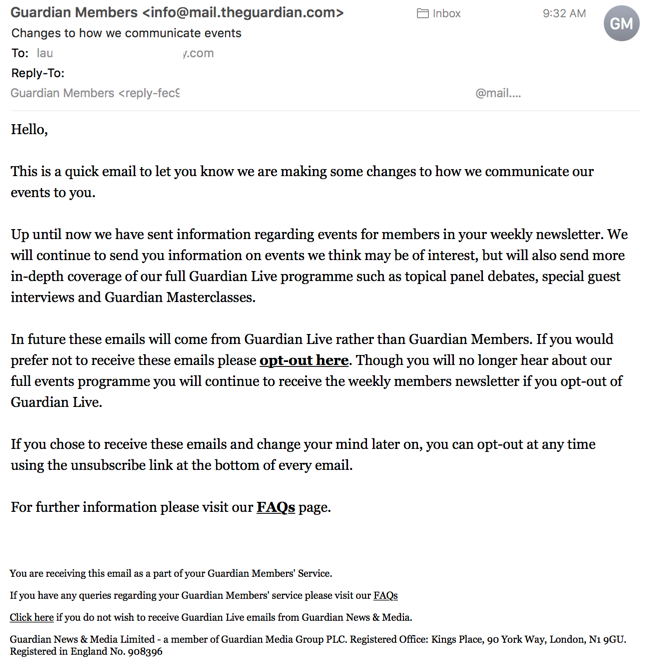
Gmail filtering in a nutshell
- laura
- Feb 10, 2017
Gmail’s approach to filtering; as described by one of the old timers. This person was dealing with network abuse back when I was still slinging DNA around as my job and just reading headers as a hobby.
Read MoreFun with opinions
- laura
- Feb 9, 2017
Over the last few weeks I’ve seen a couple people get on mailing lists and make pronouncements about email. It’s great to have opinions and it’s great to share them. But they’re always a little bit right… and a little bit wrong.
Categories
Tags
- 2010
- 2016
- 2fa
- 419
- 4xx
- 554
- 5xx
- @
- Aarp
- Abacus
- Abandoned
- Aboutmyemail
- Abuse
- Abuse Desk
- Abuse Enforcement
- Abuse Prevention
- Academia
- Accreditation
- Acme
- Acquisition
- Address Book
- Addresses
- Administrivia
- Adsp
- Advanced Delivery
- Advertiser
- Advertising
- Advice
- Affiliate
- Affiliates
- After the Email
- Alerts
- Algorithm
- Alice
- Alignment
- Allcaps
- Alt Text
- AMA
- Amazon
- Amp
- Amsterdam
- Analysis
- Anecdotes
- Anti-Spam
- Anti-Spam Laws
- Anti-Spammers
- Antwort
- AOL
- Appeals
- Appearances
- Appending
- Apple
- Arc
- Arf
- Arrest
- Arrests
- Ascii
- Asides
- Ask Laura
- Askwttw
- Assertion
- Assumptions
- ATT
- Attacks
- Attention
- Attrition
- Audit
- Authentication
- Authentication. BT
- Autonomous
- Award
- B2B
- B2C
- Backhoe
- Backscatter
- Backus-Naur Form
- Banks
- Barracuda
- Barry
- Base64
- Base85
- Bcc
- Bcp
- Bear
- Bears
- Behaviour
- Benchmark
- BESS
- Best Practices
- Bgp
- BIMI
- Bit Rot
- Bitly
- Bizanga
- Black Friday
- Blackfriday
- Blacklist
- Blacklists
- Blast
- Blo
- Block
- Blockin
- Blocking
- Blocklist
- Blocklisting
- Blocklists
- Blocks
- Blog
- Blog Links
- Blogroll
- Blogs
- Bob
- Boca
- Bofa
- Book Review
- Bot
- Botnet
- Botnets
- Bots
- Bounce
- Bounce Handling
- Bounces
- Branding
- Brands
- Breach
- Breaches
- Breech
- Bronto
- Browser
- Bsi
- Bucket
- Bulk
- Bulk Folder
- Bulk Mail
- Business
- Business Filters
- Buying Leads
- Buying Lists
- C-28
- CA
- Caa
- Cabbage
- Cache
- Cadence
- CAH
- California
- Campaign
- CAN SPAM
- Canada
- Candy
- Candycandycandy
- Canonicalization
- Canspam
- Captcha
- Career Developmnent
- Careers at WttW
- Cargo Cult
- Case Law
- Cases
- CASL
- Cat
- Cbl
- CDA
- Cert
- Certificates
- Certification
- CFL
- CFWS
- Change
- Charter
- Cheat
- Cheese
- Choicepoint
- Choochoo
- Christmas
- Chrome
- Cidr
- Cisco
- Civil
- Clear.net
- Clearwire.net
- Cli
- Click
- Click Through
- Click Tracking
- Clicks
- Clickthrough
- Client
- Cloudflare
- Cloudmark
- Cname
- Co-Reg
- Co-Registration
- Cocktail
- Code
- COI
- Comcast
- Comments
- Commercial
- Communication
- Community
- Comodo
- Comparison
- Competitor
- Complaint
- Complaint Rates
- Complaints
- Compliance
- Compromise
- Conference
- Conferences
- Confirmation
- Confirmed (Double) Opt-In
- Confirmed Opt-In
- Congress
- Consent
- Conservatives
- Consistency
- Constant Contact
- Consultants
- Consulting
- Content
- Content Filters
- Contracts
- Cookie
- Cookie Monster
- COPL
- Corporate
- Cost
- Court Ruling
- Cox
- Cox.net
- Cpanel
- Crib
- Crime
- CRM
- Crowdsource
- Crtc
- Cryptography
- CSRIC
- CSS
- Curl
- Customer
- Cyber Monday
- Czar
- Data
- Data Hygiene
- Data Security
- Data Segmentation
- Data Verification
- DBL
- Dbp
- Ddos
- Dea
- Dead Addresses
- Dedicated
- Dedicated IPs
- Defamation
- Deferral
- Definitions
- Delays
- Delisting
- Deliverability
- Deliverability Experts
- Deliverability Improvement
- Deliverability Summit
- Deliverability Week
- Deliverability Week 2024
- Deliverabiltiy
- DeliverabiltyWeek
- Delivery Blog Carnival
- Delivery Discussion
- Delivery Emergency
- Delivery Experts
- Delivery Improvement
- Delivery Lore
- Delivery News
- Delivery Problems
- Dell
- Design
- Desks
- Dhs
- Diagnosis
- Diff
- Dig
- Direct Mag
- Direct Mail
- Directives
- Discounts
- Discovery
- Discussion Question
- Disposable
- Dk
- DKIM
- Dkim2
- Dkimcore
- DMA
- DMARC
- DMARCbis
- DNS
- Dnsbl
- Dnssec
- Docs
- Doingitright
- Domain
- Domain Keys
- Domain Reputation
- DomainKeys
- Domains
- Domains by Proxy
- Dontpanic
- Dot Stuffing
- Dotcom
- Double Opt-In
- Dublin
- Dyn
- Dynamic Email
- E360
- Earthlink
- Ec2
- Ecoa
- Economics
- ECPA
- Edatasource
- Edns0
- Eec
- Efail
- Efax
- Eff
- Election
- Email Address
- Email Addresses
- Email Change of Address
- Email Client
- Email Design
- Email Formats
- Email Marketing
- Email Strategy
- Email Verification
- Emailappenders
- Emailgeeks
- Emails
- Emailstuff
- Emoji
- Emoticon
- Encert
- Encryption
- End User
- Endusers
- Enforcement
- Engagement
- Enhanced Status Code
- Ennui
- Entrust
- Eol
- EOP
- Epsilon
- Esp
- ESPC
- ESPs
- EU
- Ev Ssl
- Evaluating
- Events
- EWL
- Exchange
- Excite
- Expectations
- Experience
- Expires
- Expiring
- False Positives
- FAQ
- Fathers Day
- Fbl
- FBL Microsoft
- FBLs
- Fbox
- FCC
- Fcrdns
- Featured
- Fedex
- Feds
- Feedback
- Feedback Loop
- Feedback Loops
- Fiction
- Filter
- Filter Evasion
- Filtering
- Filterings
- Filters
- Fingerprinting
- Firefox3
- First Amendment
- FISA
- Flag Day
- Forensics
- Format
- Formatting
- Forms
- Forwarding
- Fraud
- Freddy
- Frequency
- Friday
- Friday Spam
- Friendly From
- From
- From Address
- FTC
- Fussp
- Gabbard
- Game
- GDPR
- Geoip
- Gevalia
- Gfi
- Git
- Giveaway
- Giving Up
- Global Delivery
- Glossary
- Glyph
- Gmail
- Gmails
- Go
- Godaddy
- Godzilla
- Good Email Practices
- Good Emails in the Wild
- Goodmail
- Google Buzz
- Google Postmaster Tools
- Graphic
- GreenArrow
- Greylisting
- Greymail
- Groupon
- GT&U
- Guarantee
- Guest Post
- Guide
- Habeas
- Hack
- Hacking
- Hacks
- Hall of Shame
- Harassment
- Hard Bounce
- Harvesting
- Harvey
- Hash
- Hashbusters
- Headers
- Heartbleed
- Hearts
- HELO
- Help
- Henet
- Highspeedinternet
- Hijack
- History
- Holiday
- Holidays
- Holomaxx
- Hostdns4u
- Hostile
- Hostname
- Hotmail
- How To
- Howto
- Hrc
- Hsts
- HTML
- HTML Email
- Http
- Huey
- Humanity
- Humor
- Humour
- Hygiene
- Hypertouch
- I18n
- ICANN
- Icloud
- IContact
- Identity
- Idiots
- Idn
- Ietf
- Image Blocking
- Images
- Imap
- Inbox
- Inbox Delivery
- Inboxing
- Index
- India
- Indiegogo
- Industry
- Infection
- Infographic
- Information
- Inky
- Inline
- Innovation
- Insight2015
- Integration
- Internationalization
- Internet
- Intuit
- IP
- IP Address
- Ip Addresses
- IP Repuation
- IP Reputation
- IPhone
- IPO
- IPv4
- IPv6
- Ironport
- Ironport Cisco
- ISIPP
- ISP
- ISPs
- J.D. Falk Award
- Jail
- Jaynes
- JD
- Jobs
- Json
- Junk
- Juno/Netzero/UOL
- Key Rotation
- Keybase
- Keynote
- Kickstarter
- Kraft
- Laposte
- Lavabit
- Law
- Laws
- Lawsuit
- Lawsuits
- Lawyer
- Layout
- Lead Gen
- Leak
- Leaking
- Leaks
- Legal
- Legality
- Legitimate Email Marketer
- Letsencrypt
- Letstalk
- Linked In
- Links
- List Hygiene
- List Management
- List Purchases
- List the World
- List Usage
- List-Unsubscribe
- Listing
- Listmus
- Lists
- Litmus
- Live
- Livingsocial
- London
- Lookup
- Lorem Ipsum
- Lycos
- Lyris
- M3AAWG
- Maawg
- MAAWG2007
- Maawg2008
- MAAWG2012
- MAAWGSF
- Machine Learning
- Magill
- Magilla
- Mail Chimp
- Mail Client
- MAIL FROM
- Mail Privacy Protection
- Mail Problems
- Mail.app
- Mail.ru
- Mailboxes
- Mailchimp
- Mailgun
- Mailing Lists
- Mailman
- Mailop
- Mainsleaze
- Maitai
- Malicious
- Malicious Mail
- Malware
- Mandrill
- Maps
- Marketer
- Marketers
- Marketing
- Marketo
- Markters
- Maths
- Mcafee
- Mccain
- Me@privacy.net
- Measurements
- Media
- Meh
- Meltdown
- Meme
- Mentor
- Merry
- Message-ID
- Messagelabs
- MessageSystems
- Meta
- Metric
- Metrics
- Micdrop
- Microsoft
- Milter
- Mime
- Minimal
- Minshare
- Minute
- Mit
- Mitm
- Mobile
- Models
- Monitoring
- Monkey
- Monthly Review
- Mpp
- MSN/Hotmail
- MSN/Hotmail
- MTA
- Mua
- Mutt
- Mx
- Myths
- Myvzw
- Needs Work
- Netcat
- Netsol
- Netsuite
- Network
- Networking
- New Year
- News
- News Articles
- Nhi
- NJABL
- Now Hiring
- NTP
- Nxdomain
- Oath
- Obituary
- Office 365
- Office365
- One-Click
- Only Influencers
- Oops
- Opaque Cookie
- Open
- Open Detection
- Open Rate
- Open Rates
- Open Relay
- Open Tracking
- Opendkim
- Opens
- Openssl
- Opt-In
- Opt-Out
- Optonline
- Oracle
- Outage
- Outages
- Outblaze
- Outlook
- Outlook.com
- Outrage
- Outreach
- Outsource
- Ownership
- Owning the Channel
- P=reject
- Pacer
- Pander
- Panel
- Password
- Patent
- Paypal
- PBL
- Penkava
- Permission
- Personalities
- Personalization
- Personalized
- Pgp
- Phi
- Philosophy
- Phish
- Phishers
- Phishing
- Phising
- Photos
- Pii
- PIPA
- PivotalVeracity
- Pix
- Pluscachange
- Podcast
- Policies
- Policy
- Political Mail
- Political Spam
- Politics
- Porn
- Port25 Blocking
- Postfix
- Postmaster
- Power MTA
- Practices
- Predictions
- Preferences
- Prefetch
- Preview
- Primers
- Privacy
- Privacy Policy
- Privacy Protection
- Private Relay
- Productive Mail
- Promotions
- Promotions Tab
- Proofpoint
- Prospect
- Prospecting
- Protocols
- Proxy
- Psa
- PTR
- Public Suffix List
- Purchased
- Purchased Lists
- Purchases
- Purchasing Lists
- Questions
- Quoted Printable
- Rakuten
- Ralsky
- Rant
- Rate Limiting
- Ray Tomlinson
- Rc4
- RDNS
- Re-Engagement
- Read
- Ready to Post
- Readytopost
- Real People
- Realtime Address Verification
- Recaptcha
- Received
- Receivers
- Recipient
- Recipients
- Redirect
- Redsnapper
- Reference
- Registrar
- Registration
- Rejection
- Rejections
- Rejective
- Relationship
- Relevance
- Relevancy
- Removals
- Render Rate
- Rendering
- Replay
- Repost
- Repudiation
- Reputation
- Requirements
- Research
- Resources
- Responsive
- Responsive Design
- Responsys
- Retail
- Retired Domains
- Retro
- Return Path
- Return Path Certified
- ReturnPath
- Reunion.com
- Reverse Dns
- RFC
- RFC2047
- RFC2821/2822
- RFC5321/5322
- RFC5322
- RFC8058
- RFC821/822
- RFCs
- Roadr
- RoadRunner
- Rodney Joffe
- ROKSO
- Role Accounts
- Rollout
- RPost
- RPZ
- Rule 34
- Rules
- Rum
- Rustock
- S.1618
- SaaS
- Sales
- Salesforce
- Sass
- SBCGlobal
- Sbl
- Scam
- Scammers
- Scams
- Scanning
- Scraping
- Screamer
- Screening
- Script
- Sec
- Secure
- Security
- Segmentation
- Selligent
- Send
- Sender
- Sender Score
- Sender Score Certified
- Senderbase
- Senderid
- Senders
- Senderscore
- Sendgrid
- Sending
- Sendy
- Seo
- Service
- Services
- Ses
- Seth Godin
- SFDC
- SFMAAWG2009
- SFMAAWG2010
- SFMAAWG2014
- Shared
- Shell
- Shouting
- Shovel
- Signing
- Signups
- Silly
- Single Opt-In
- Slack
- Slicing
- Smarthost
- Smiley
- Smime
- SMS
- SMTP
- Snds
- Snowshoe
- Soa
- Socia
- Social Media
- Social Networking
- Soft Bounce
- Software
- Sony
- SOPA
- Sorbs
- Spam
- Spam Blocking
- Spam Definition
- Spam Filtering
- Spam Filters
- Spam Folder
- Spam Law
- Spam Laws
- Spam Reports
- Spam Traps
- Spam. IMessage
- Spamarrest
- Spamassassin
- Spamblocking
- Spamcannibal
- Spamcon
- Spamcop
- Spamfiltering
- Spamfilters
- Spamfolder
- Spamhaus
- Spamhause
- Spammer
- Spammers
- Spammest
- Spamming
- Spamneverstops
- Spamresource
- Spamtrap
- Spamtraps
- Spamza
- Sparkpost
- Speaking
- Special Offers
- Spectre
- SPF
- Spoofing
- SproutDNS
- Ssl
- Standards
- Stanford
- Starttls
- Startup
- State Spam Laws
- Statistics
- Stealth
- Storm
- Strategy
- Stripo
- Stunt
- Subject
- Subject Lines
- Subscribe
- Subscriber
- Subscribers
- Subscription
- Subscription Process
- Success Stories
- Suing
- Suppression
- Surbl
- Sureclick
- Suretymail
- Survey
- Swaks
- Syle
- Symantec
- Tabbed Inbox
- Tabs
- Tagged
- Tagging
- Target
- Targeting
- Techincal
- Technical
- Telnet
- Template
- Tempo
- Temporary
- Temporary Failures
- Terminology
- Testing
- Text
- Thanks
- This Is Spam
- Throttling
- Time
- Timely
- TINS
- TLD
- Tlp
- TLS
- TMIE
- Tmobile
- Too Much Mail
- Tool
- Tools
- Toomuchemail
- Tor
- Trademark
- Traffic Light Protocol
- Tragedy of the Commons
- Transactional
- Transition
- Transparency
- Traps
- Travel
- Trend/MAPS
- Trend Micro
- Trend/MAPS
- Trigger
- Triggered
- Troubleshooting
- Trustedsource
- Turscar
- TWSD
- Txt
- Types of Email
- Typo
- Uce
- UCEprotect
- Unblocking
- Uncategorized
- Undisclosed Recipients
- Unexpected Email
- Unicode
- Unroll.me
- Unsolicited
- Unsubcribe
- Unsubscribe
- Unsubscribed
- Unsubscribes
- Unsubscribing
- Unsubscription
- Unwanted
- URIBL
- Url
- Url Shorteners
- Usenet
- User Education
- Utf8
- Valentine's Day
- Validation
- Validity
- Value
- Valueclick
- Verification
- Verizon
- Verizon Media
- VERP
- Verticalresponse
- Vetting
- Via
- Video
- Violence
- Virginia
- Virtumundo
- Virus
- Viruses
- Vmc
- Vocabulary
- Vodafone
- Volume
- Vzbv
- Wanted Mail
- Warmup
- Weasel
- Webinar
- Webmail
- Weekend Effect
- Welcome Emails
- White Space
- Whitelisting
- Whois
- Wiki
- Wildcard
- Wireless
- Wiretapping
- Wisewednesday
- Women of Email
- Woof
- Woot
- Wow
- Wtf
- Wttw in the Wild
- Xbl
- Xfinity
- Xkcd
- Yahoo
- Yahoogle
- Yogurt
- Zoidberg
- Zombie
- Zombies
- Zoominfo
- Zurb